Table of Contents
1. Introduction: Why Sound Therapy Is Used for Tinnitus
If you’ve ever experienced that persistent ringing, buzzing, or hissing in your ears when no external sound exists, you understand how frustrating tinnitus can be. What many people don’t realize is that sound therapy for tinnitus has become one of the most widely recommended approaches by audiologists, not because it’s a quick fix, but because it addresses tinnitus where it actually occurs: in the brain.
Tinnitus isn’t purely an ear problem. While it often starts with hearing damage or auditory system changes, the phantom sounds you hear are generated by neurological processes in your brain’s auditory cortex. This is why medications that target the ear often fail, and why understanding what is sound therapy for tinnitus can open new pathways to relief.
In this comprehensive guide, you’ll discover how sound therapy works at the neural level, the different types available, what clinical evidence says about effectiveness, and practical strategies for implementation. Whether you’re newly diagnosed or have been struggling with tinnitus for years, understanding sound therapy treatment for tinnitus can help you make informed decisions about managing this challenging condition.
Key Takeaway: Sound therapy aims to reduce how strongly the brain reacts to tinnitus not necessarily to eliminate the sound itself.
2. What Is Sound Therapy for Tinnitus?
Sound therapy is a therapeutic approach that uses carefully selected external sounds to change how your brain perceives and responds to tinnitus. Unlike medications or supplements that attempt to alter body chemistry, sound therapy works through environmental modification and neural adaptation.
The primary goal isn’t to “cure” tinnitus or make it disappear entirely. Instead, sound therapy focuses on:
- Reducing tinnitus awareness throughout the day
- Decreasing the emotional distress associated with the phantom sounds
- Breaking the cycle of negative attention that amplifies perception
- Promoting habituation so your brain learns to filter out tinnitus
Think of it this way: imagine a ticking clock in a silent room at night. Every tick feels impossibly loud and intrusive. Now imagine that same clock ticking in a café with soft background music, conversation, and ambient noise. The clock hasn’t changed, but your ability to ignore it has improved dramatically. Sound therapy works on this same principle it provides acoustic enrichment that helps your brain categorize tinnitus as unimportant background information.
| Sound Therapy | Other Tinnitus Treatments |
|---|---|
| Uses external sound to retrain brain perception | May use medication, supplements, or surgery |
| Non-invasive and low-risk | Can have side effects or complications |
| Focuses on reducing distress and awareness | May target underlying physical causes |
| Works through neuroplasticity | Works through chemical or structural changes |
Key Insight: Sound therapy works by changing perception, not by “fixing” ear damage.
3. How Sound Therapy Works in the Brain
3.1 The Role of the Auditory Cortex
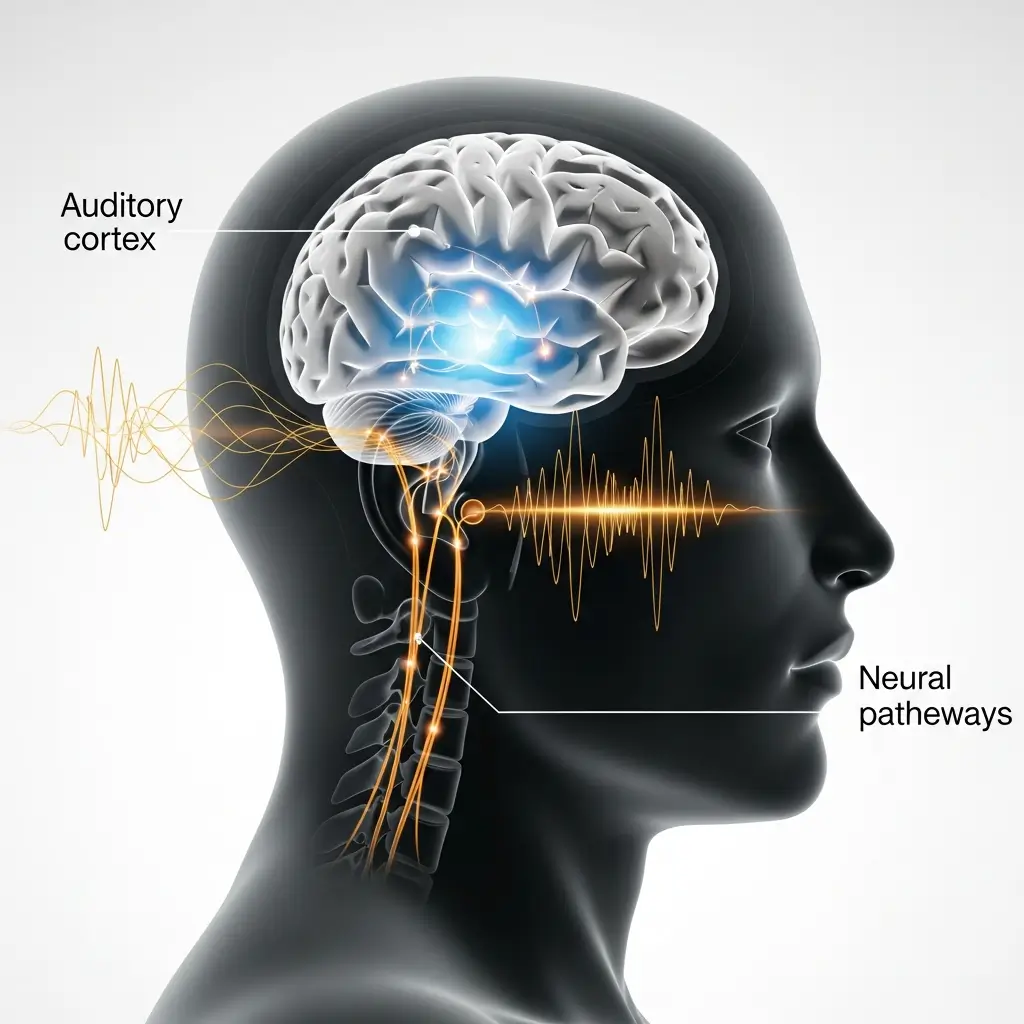
To understand how sound therapy helps, we need to look at what’s happening in your brain when tinnitus develops. Research shows that tinnitus often results from abnormal neural firing patterns in the auditory cortex, the brain region responsible for processing sound.
When hearing damage occurs (from noise exposure, aging, or other factors), certain frequencies may no longer reach the brain through normal channels. In response, the auditory cortex becomes hyperactive, essentially “turning up the volume” to search for missing input. This increased neural activity manifests as the phantom sounds we call tinnitus.
Here’s the counterintuitive part: silence can actually worsen tinnitus perception. In quiet environments, your brain has fewer competing signals, which makes the abnormal neural firing stand out more prominently. This is why many people notice their tinnitus most severely at night or in quiet rooms.
3.2 Neuroplasticity and Habituation
The good news is that your brain possesses remarkable adaptability through a process called neuroplasticity. This is the brain’s ability to reorganize neural pathways based on experience and environmental input.
Sound therapy leverages neuroplasticity by providing consistent, structured auditory input that:
- Reduces auditory cortex hyperactivity by giving the brain actual sounds to process
- Promotes habituation by training the brain to classify tinnitus as unimportant
- Decreases limbic system activation (the emotional center) associated with tinnitus distress
It’s important to distinguish between habituation and masking. Masking simply covers up tinnitus temporarily with louder sounds. Habituation, on the other hand, is a neural learning process where your brain gradually filters out tinnitus signals as irrelevant, similar to how you stop noticing the feeling of clothes on your skin throughout the day.
Scientific support for these mechanisms comes from multiple sources:
- Studies published in Frontiers in Neuroscience have documented measurable changes in auditory cortex activity following consistent sound therapy
- Research in Hearing Research has explored auditory gain theory, which explains how the brain compensates for hearing loss and how therapeutic sound can normalize this process
- The American Tinnitus Association provides comprehensive resources on the neurological basis of tinnitus
Key Understanding: Sound therapy uses the brain’s adaptability to reduce tinnitus prominence over time.
4. Types of Sound Therapy for Tinnitus
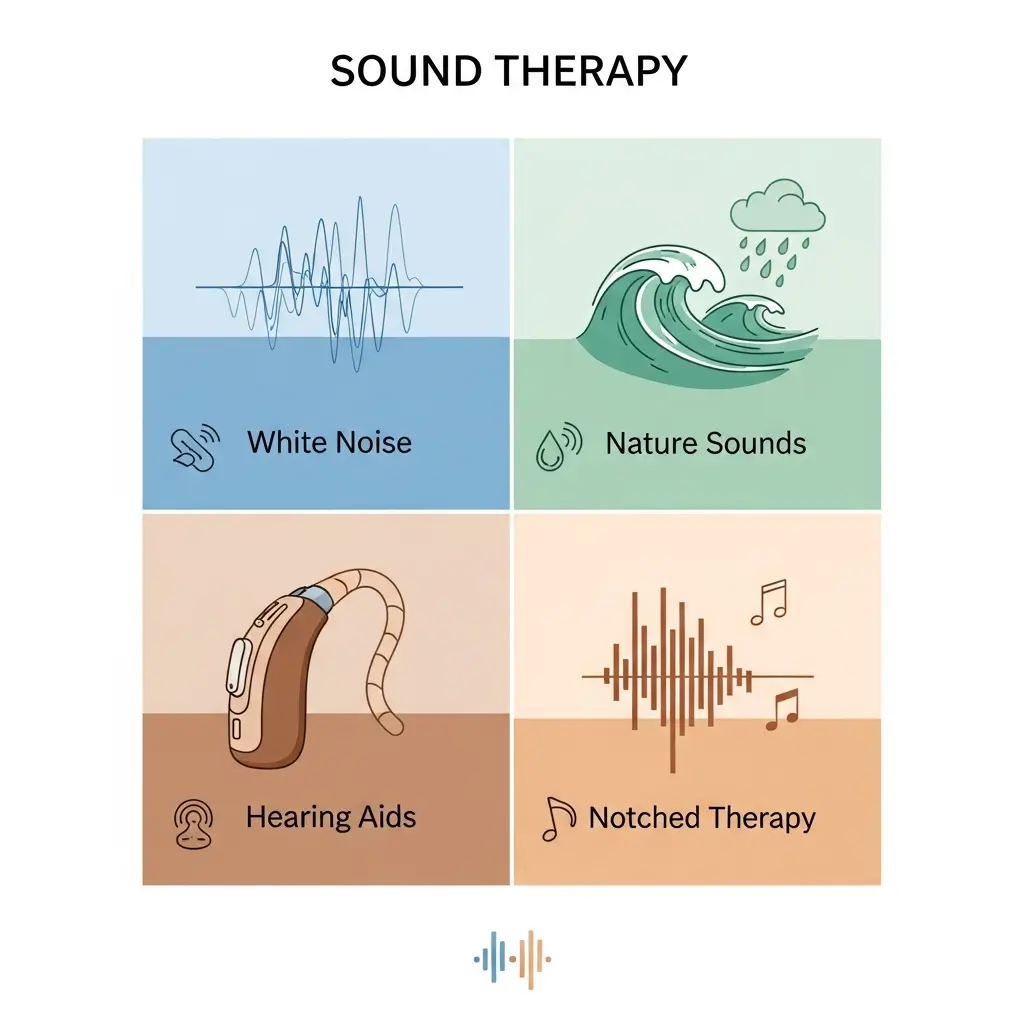
One of the most empowering aspects of sound therapy is the variety of options available. What works best depends on your specific tinnitus characteristics, lifestyle, and personal preferences.
4.1 White Noise and Broadband Noise
White noise contains all audible frequencies at equal intensity, creating a static-like sound. Broadband noise is similar but may emphasize certain frequency ranges.
Best for:
- Sleep environments
- Quiet office settings
- Nighttime tinnitus that intensifies in silence
How to use: Play at a low, comfortable volume just loud enough to provide acoustic enrichment without completely masking your tinnitus.
4.2 Nature Sounds (Ocean, Rain, Forest)
Natural soundscapes, such as ocean waves, rainfall, or forest ambiance, offer therapeutic benefits beyond simple acoustic enrichment.
Why they work:
- Activate calming responses in the limbic system
- Reduce stress and anxiety that often exacerbate tinnitus
- Create pleasant auditory environments that improve quality of life
Best for: Stress-related or anxiety-linked tinnitus, relaxation, and improving sleep quality.
4.3 Notched Music Therapy
This innovative approach involves filtering music to remove the specific frequency that matches your tinnitus tone. The theory is that repeated exposure to “notched” music can reduce the hyperactivity at that particular frequency in your auditory cortex.
Key considerations:
- Requires professional testing to identify your exact tinnitus frequency
- Shows promise in research settings
- May not work for complex or multi-tonal tinnitus
4.4 Hearing Aids with Sound Generators
For the 80-90% of tinnitus sufferers who also have hearing loss, combination devices offer dual benefits.
Advantages:
- Amplifies external sounds to reduce auditory cortex hyperactivity
- Includes built-in sound generators for additional therapy
- Addresses both hearing loss and tinnitus simultaneously
Modern hearing aids can be programmed specifically for tinnitus management with customizable therapeutic sounds.
4.5 Neuromodulation-Based Sound Therapy
Emerging treatments pair sound stimulation with electrical or magnetic nerve stimulation to more directly influence neural pathways.
Current status:
- Still under clinical investigation
- Shows potential in early studies
- Not yet widely available or FDA-approved for tinnitus
| Sound Therapy Type | Best For | Accessibility | Evidence Level |
|---|---|---|---|
| White/Broadband Noise | General use, sleep | High (apps, devices) | Strong |
| Nature Sounds | Stress-related tinnitus | High (apps, recordings) | Moderate |
| Notched Music | Specific-frequency tinnitus | Medium (requires testing) | Moderate |
| Hearing Aids | Tinnitus + hearing loss | Medium (requires audiologist) | Strong |
| Neuromodulation | Research purposes | Low (experimental) | Emerging |
Important Note: Different sound therapies suit different tinnitus profiles, there is no one-size-fits-all solution.
5. Sound Therapy vs Simple Masking: Key Differences
Many people confuse sound therapy with simple masking, but understanding the distinction is crucial for successful tinnitus management.
Masking involves playing sounds loud enough to completely cover your tinnitus. While this provides temporary relief, it offers several drawbacks:
- Benefits disappear immediately when the sound stops
- Requires increasingly loud volumes over time
- Doesn’t promote neural adaptation
- May actually increase auditory cortex hyperactivity when silence returns
Therapeutic sound therapy takes a different approach:
- Uses sounds at lower, sub-masking levels
- Allows you to still hear your tinnitus while reducing its prominence
- Promotes habituation through consistent, long-term exposure
- Creates lasting changes in neural processing
Think of it like this: masking is like turning up music to ignore pain, offering only distraction. Therapy is like physical rehabilitation for the nervous system, creating actual functional improvement over time.
Clinical evidence supports the therapeutic approach. Studies show that complete masking can actually delay habituation, while partial masking or sound enrichment facilitates neural adaptation.
Critical Distinction: Effective sound therapy focuses on long-term brain retraining, not just short-term distraction.
6. How Effective Is Sound Therapy for Tinnitus?
The question everyone wants answered: Does sound therapy actually work? The research provides encouraging but nuanced answers.
Clinical studies consistently demonstrate that sound therapy significantly reduces tinnitus-related distress, even when the perceived loudness of tinnitus remains unchanged. This is measured using validated tools like:
- Tinnitus Handicap Inventory (THI): Assesses functional, emotional, and catastrophic impacts
- Tinnitus Functional Index (TFI): Measures multiple dimensions of tinnitus severity
- Visual Analog Scales: Track subjective distress levels over time
Key findings from peer-reviewed research:
According to systematic reviews in the Cochrane Database of Systematic Reviews, sound therapy shows:
- Moderate to significant improvement in quality of life scores
- Reduced scores on tinnitus distress questionnaires
- Better sleep quality in many participants
- Decreased anxiety and depression related to tinnitus
The Journal of the American Academy of Audiology has published multiple studies demonstrating that consistent use of therapeutic sound leads to measurable improvements in tinnitus management, with success rates varying from 40% to 80% depending on the specific protocol and patient population.
Important expectation management:
Sound therapy more reliably reduces emotional distress and awareness than actual loudness perception. Many successful users report:
- “I still hear it, but it doesn’t bother me anymore.”
- “I only notice it when I think about it.”
- “It’s there, but I can function normally now.”
This aligns with what we understand about habituation, the goal isn’t silence, but rather neural adaptation that diminishes the tinnitus signal’s importance to your conscious awareness.
Evidence Summary: Sound therapy consistently reduces tinnitus distress, even if loudness remains unchanged.
7. How Long Does Sound Therapy Take to Work?
One of the most common reasons sound therapy fails is unrealistic expectations about timing. Unlike taking pain medication that works in minutes, neural adaptation is a gradual process.
Typical timeline:
- Weeks 1-4: You may notice improved sleep or a slight reduction in stress, but tinnitus perception likely remains unchanged
- Months 2-3: Some people begin experiencing periods where they forget about their tinnitus for hours at a time
- Months 4-6: Habituation often becomes more apparent; distress levels typically decrease measurably
- 6-12 months: Maximum benefits usually emerge with consistent, daily use
Factors influencing success rate and timeline:
- Consistency: Daily use is essential; sporadic sound therapy won’t create lasting neural changes
- Stress levels: High stress activates the limbic system, making habituation more difficult
- Sleep quality: Poor sleep affects neuroplasticity and emotional regulation
- Hearing loss severity: More significant hearing loss may require longer adaptation periods
- Tinnitus duration: Chronic tinnitus (present for years) often requires more time than recent-onset cases
Think of it like learning a musical instrument or a new language, your brain needs repeated exposure over time to create new neural pathways. There are no shortcuts to neuroplasticity.
Patience Required: Sound therapy is gradual benefits build through repetition, not instant relief.
8. Best Practices for Using Sound Therapy Correctly
The effectiveness of sound therapy depends heavily on proper implementation. Follow these evidence-based guidelines:
Essential Practices:
Avoid complete silence
- Use sound enrichment throughout the day, especially in quiet environments
- Even low-level background sound helps prevent auditory cortex hyperactivity
- Consider using sound during work, reading, or other quiet activities
Use sound at low, comfortable levels
- Set volume just below or equal to your tinnitus loudness (mixing point)
- Never completely mask your tinnitus; you should still hear it faintly
- Avoid the temptation to turn the volume too high for complete relief
Combine with relaxation or mindfulness
- Sound therapy works better when your nervous system is calm
- Practice deep breathing, progressive relaxation, or meditation while using therapeutic sound
- This combination enhances habituation by reducing limbic system activation
Use during sleep if tinnitus worsens at night
- Place sound sources near (not on) your pillow
- Use timer functions to allow natural sleep after falling asleep
- Experiment with different sounds to find what promotes the best sleep quality
Additional Tips:
- Consistency beats variety: Stick with one or two sound types rather than constantly switching
- Create sound-rich environments: Open windows, use fans, play background music at low volumes
- Use multiple sound sources: Different sounds for different situations (sleep, work, relaxation)
- Track your progress: Keep a simple journal, noting distress levels. Weekly improvement can be gradual enough that you don’t notice without tracking
Success Formula: Correct use matters more than the type of sound chosen.
9. Who Benefits Most from Sound Therapy?
While sound therapy can help many tinnitus sufferers, certain profiles tend to experience the greatest improvements:
Ideal candidates:
- Chronic tinnitus sufferers (present for 6+ months) who have completed a medical evaluation
- Noise-induced tinnitus from occupational or recreational sound exposure
- Age-related tinnitus associated with presbycusis (age-related hearing loss)
- Anxiety-linked tinnitus where emotional response amplifies perception
- People with hearing loss and tinnitus who can benefit from amplification plus sound therapy
Characteristics associated with better outcomes:
- Willingness to commit to daily, long-term use
- Openness to gradual improvement rather than an instant cure
- Ability to manage stress and practice relaxation techniques
- Understanding that the goal is habituation, not elimination
- Supportive audiologist or hearing healthcare professional for guidance
Even if you don’t fit the ideal profile perfectly, sound therapy’s low-risk nature makes it worth trying for virtually anyone with bothersome tinnitus.
10. Limitations and When Sound Therapy May Not Help
Sound therapy is a valuable tool, but it’s not appropriate for every type of tinnitus or every situation.
When sound therapy may be less effective or inappropriate:
Sudden-onset tinnitus (less than 3 months)
- May resolve spontaneously
- Requires medical evaluation to rule out treatable causes
- Sound therapy can be used, but shouldn’t delay proper diagnosis
Pulsatile tinnitus (rhythmic, heartbeat-like)
- Often indicates vascular or structural issues
- May have treatable underlying causes
- Requires imaging and specialist evaluation before beginning sound therapy
Tinnitus with red flags:
- Unilateral (one-sided only) tinnitus
- Associated with dizziness, balance problems, or neurological symptoms
- Rapidly worsening hearing loss
- Pain or discharge from the ear
Structural or vascular causes:
- Acoustic neuromas (benign tumors)
- Vascular malformations
- Temporomandibular joint (TMJ) disorders
- Certain medications (ototoxic drugs)
Critical point: Always seek medical evaluation from an audiologist or ENT specialist before beginning sound therapy. Proper diagnosis ensures you’re not missing a treatable underlying condition.
Sound therapy should complement medical care, not replace it. Think of it as physical therapy, valuable for rehabilitation but not a substitute for proper diagnosis of structural problems.
Medical First: Sound therapy is supportive, not a substitute for diagnosis.
11. Sound Therapy Combined with Other Treatments

Research increasingly shows that multimodal approaches produce the best outcomes for tinnitus management. Sound therapy works most effectively when integrated with complementary strategies.
Cognitive Behavioral Therapy (CBT)
CBT for tinnitus addresses the negative thought patterns and emotional responses that amplify distress.
How it complements sound therapy:
- Sound therapy changes the acoustic environment
- CBT changes how you interpret and respond to tinnitus
- The combined approach addresses both neural adaptation and psychological resilience
Studies show that CBT plus sound therapy produces greater improvements in quality of life than either approach alone.
Meditation and Mindfulness
Mindfulness practices teach present-moment awareness without judgment incredibly valuable for tinnitus management.
Benefits:
- Reduces stress-driven tinnitus amplification
- Improves the ability to observe tinnitus without a negative reaction
- Enhances the habituation process that sound therapy promotes
- Lowers limbic system activation
Even 10-15 minutes daily of mindfulness practice can measurably improve tinnitus-related distress.
Lifestyle Modifications
Several lifestyle factors significantly impact tinnitus severity:
Sleep optimization:
- Consistent sleep schedule
- Sound therapy during sleep
- Sleep hygiene practices (dark room, cool temperature, no screens before bed)
Caffeine and alcohol moderation:
- Both can temporarily worsen tinnitus in some individuals
- Monitor your own response and adjust intake accordingly
Stress management:
- Regular exercise
- Time in nature
- Social connection
- Professional stress reduction techniques
Hearing protection:
- Prevent further hearing damage
- Use earplugs or earmuffs in noisy environments
- Avoid excessive headphone use at high volumes
Scientific backing from The Lancet tinnitus management guidelines emphasizes the importance of comprehensive care that addresses acoustic, psychological, and lifestyle factors simultaneously.
Integrated Approach: Sound therapy works best as part of a multi-approach strategy.
12. Final Verdict: Is Sound Therapy Worth Trying?
After reviewing the mechanisms, evidence, and practical considerations, here’s the bottom line on sound therapy for tinnitus:
The Case For Sound Therapy:
- Evidence-based: Supported by peer-reviewed research and clinical guidelines
- Low-risk: No significant side effects or dangers
- Accessible: Can be implemented with apps, devices, or hearing aids
- Addresses root cause: Works with the brain’s neuroplasticity rather than masking symptoms
- Proven distress reduction: Consistently improves quality of life measures
- Complementary: Works well with other tinnitus management strategies
Realistic Expectations:
Sound therapy is not:
- An instant cure or quick fix
- Guaranteed to eliminate tinnitus perception
- Effective for everyone in all situations
- A replacement for medical diagnosis
Sound therapy is:
- A gradual retraining process requires patience
- Most effective at reducing emotional distress and awareness
- Best used consistently over months
- Most successful when combined with stress management and healthy habits
Who Should Try It:
Sound therapy is especially worth trying if you:
- Have chronic tinnitus that has been medically evaluated
- Experience distress, anxiety, or sleep disruption from tinnitus
- Are you willing to commit to daily use for several months
- Want a low-risk, non-invasive management option
- Prefer addressing tinnitus through natural brain adaptation
Implementation Steps:
- Get a proper diagnosis from an audiologist or ENT specialist
- Choose your sound therapy type based on your preferences and tinnitus characteristics
- Start with accessible options like apps or sound machines
- Use consistently at appropriate volumes (low, background levels)
- Track your progress using a simple distress scale
- Be patient and give the process at least 3-6 months
- Consider professional guidance for personalized protocols
- Integrate with lifestyle changes for maximum benefit
Final Summary: Sound therapy doesn’t silence tinnitus but it can dramatically quiet its impact on daily life.
Take Action Today
If you’re ready to explore sound therapy for your tinnitus, start with these practical steps:
- Download a reputable tinnitus app with various sound options
- Schedule an appointment with an audiologist for a comprehensive hearing evaluation
- Explore cognitive behavioral therapy resources specifically designed for tinnitus
- Begin a simple journal tracking your daily tinnitus distress levels
- Research hearing aids with sound therapy features if you also have hearing loss
Remember that managing tinnitus is a journey, not a destination. Sound therapy offers a scientifically supported, low-risk pathway to reducing the burden that tinnitus places on your daily life. While it may not provide the silence you hope for, it can restore peace, improve sleep, and help you reclaim the quality of life that tinnitus has compromised.
The key is patience, consistency, and realistic expectations. Your brain’s remarkable ability to adapt through neuroplasticity means that change is possible; it just happens gradually, one day at a time.
FAQ
What is sound therapy for tinnitus?
Sound therapy for tinnitus is a therapeutic approach that uses carefully selected external sounds to change how your brain perceives and responds to tinnitus. It works by reducing tinnitus awareness and distress through neuroplasticity and habituation rather than eliminating the sound itself.
How effective is sound therapy for tinnitus?
Clinical studies show sound therapy consistently reduces tinnitus-related distress, with success rates ranging from 40% to 80%. While it may not reduce loudness perception, it significantly improves quality of life, sleep quality, and reduces anxiety related to tinnitus.
How long does sound therapy take to work for tinnitus?
Sound therapy typically requires 4-6 months of consistent daily use before significant habituation occurs. Some people notice improvements in sleep within weeks, but maximum benefits usually emerge between 6-12 months as the brain adapts through neuroplasticity.
What are the types of sound therapy for tinnitus?
Main types include white noise and broadband noise, nature sounds (ocean, rain, forest), notched music therapy, hearing aids with sound generators, and emerging neuromodulation-based treatments. Each type suits different tinnitus profiles and personal preferences.